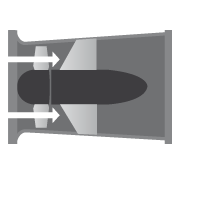
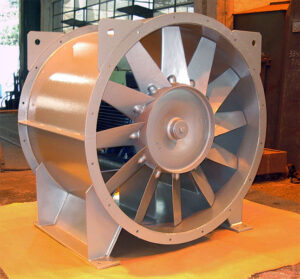
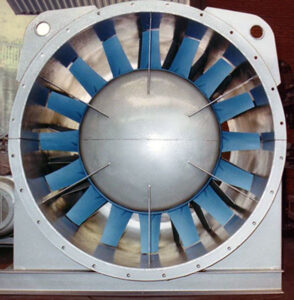
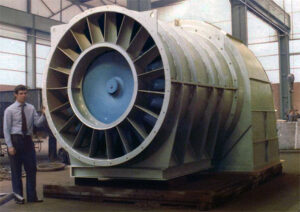

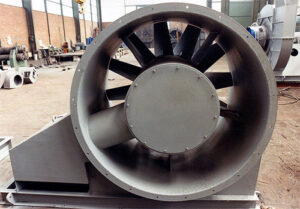
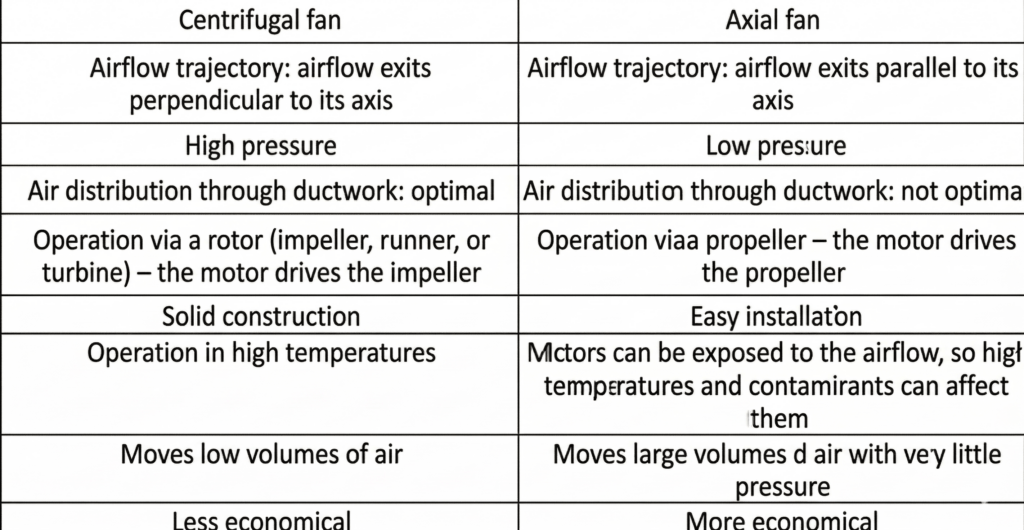

A mechanical device whose objective consists of propelling air and gases by means of a propeller formed by a variable number of blades anchored to a hub that is responsible for transmitting the energy from the shaft to the blades, allowing the air trajectory to be parallel to the axis of the propeller.
These fans are suitable for those situations where it is required to move a large amount of air at low pressure. Thanks to this, these fans are ideal for replacing the air in a closed environment with better quality air (renewing the air), making them suitable for extraction applications.
Cooling towers
Shopping centers
Parking
Mining industry
Industrial buildings
Tunnels
Textile industry
Naval industry
Industrial workshop and tunnel ventilation.
Ventilation in mining industries.
Ventilation in the shipping industry.
Ventilation in the textile industry.
Cooling towers.
Prilling towers.
Static pressure up to 180 mm.w.g. for each compression stage.
Sizes between 335 mm and 3000 mm of diameter.
Rotors made of light alloy casting with adjustable airfoil blades.
Efficiency up to 81%.
Helicoidal fan
It is one of the most common models, it is easy to install and does not require great power to change the air of a space in a short time. For its installation, the following aspects must be taken into account: airflow, pressure, noise, energy consumption, and protection.
Tubular fan
Compact size and flexible at the time of installation, since it can be placed vertically, horizontally or at a specific angle.
Tubular fan with guide vanes
Similar characteristics to the previous ones, but with higher performance and efficiency.
Wall fans: used in factories and warehouses
Jet fan: when a specific speed is needed impacting a person or target.
Duct fan (extractors: transferring air between two different spaces), according to the type of installation:
Wall fan
In-line fan (for intercalating products)
Fan for outdoor installations
The diameter of the axial fan. The larger the diameter of the fan, the greater the airflow that can be moved.
The motor power (revolutions). The airflow that the fan can move is proportional to the number of revolutions per minute and the pressure is proportional to the square of the revolutions.
Angle of the blades or vanes
Number and width, with the same amount of blades, but with greater width the useful area of the fan is increased
Acoustic level
Adding {{itemName}} to cart
Added {{itemName}} to cart